1956 → 2059: The Conjecture
The proposal
On August 31, 1955, four researchers put their names to a short proposal. John McCarthy was a young mathematician at Dartmouth College. Marvin Minsky was at Harvard, Nathaniel Rochester at IBM, and Claude Shannon at Bell Telephone Laboratories. They asked the Rockefeller Foundation for $13,500 to bring a small group of scientists to Hanover, New Hampshire, for the summer of 1956.
The second sentence of that proposal is the one that lasted:
“The study is to proceed on the basis of the conjecture that every aspect of learning or any other feature of intelligence can in principle be so precisely described that a machine can be made to simulate it.”
The field they were proposing needed a name. McCarthy gave it one: artificial intelligence.
The summer
They asked for a two-month, ten-man study. What happened was looser. According to Ray Solomonoff’s notes, the workshop ran for roughly eight weeks, from about June 18 to August 17, 1956. Only Solomonoff, Minsky and McCarthy stayed the whole time. Others came for days or weeks, among them Oliver Selfridge, Trenchard More, Arthur Samuel, Allen Newell and Herbert Simon. Newell and Simon brought the Logic Theorist, a program that proved theorems from Whitehead and Russell’s Principia Mathematica.
No single breakthrough came out of that summer. A field came out of it: a name, a community, and a confident list of problems. The proposal hoped machines could be made to “use language, form abstractions and concepts, solve kinds of problems now reserved for humans, and improve themselves.”
Seventy years
The summer became seventy years. Early optimism gave way to funding collapses in the 1970s and again in the late 1980s, the “AI winters.” Expert systems came and went. Statistical machine learning took their place, then deep learning after 2012, then the transformer in 2017 and the large language models that reached the public in 2022.
Read that 1955 list again. Machines now use language, form abstractions and handle many problems once reserved for humans, in ways the authors would recognize. The fourth item, machines that improve themselves, is now the subject of serious research and serious concern.
This month Dartmouth marks the anniversary with AI @70: What Must Remain Human?, held in Hanover on October 29–31, 2026. The Rockefeller Foundation, which funded the original summer, is supporting it again.
2059
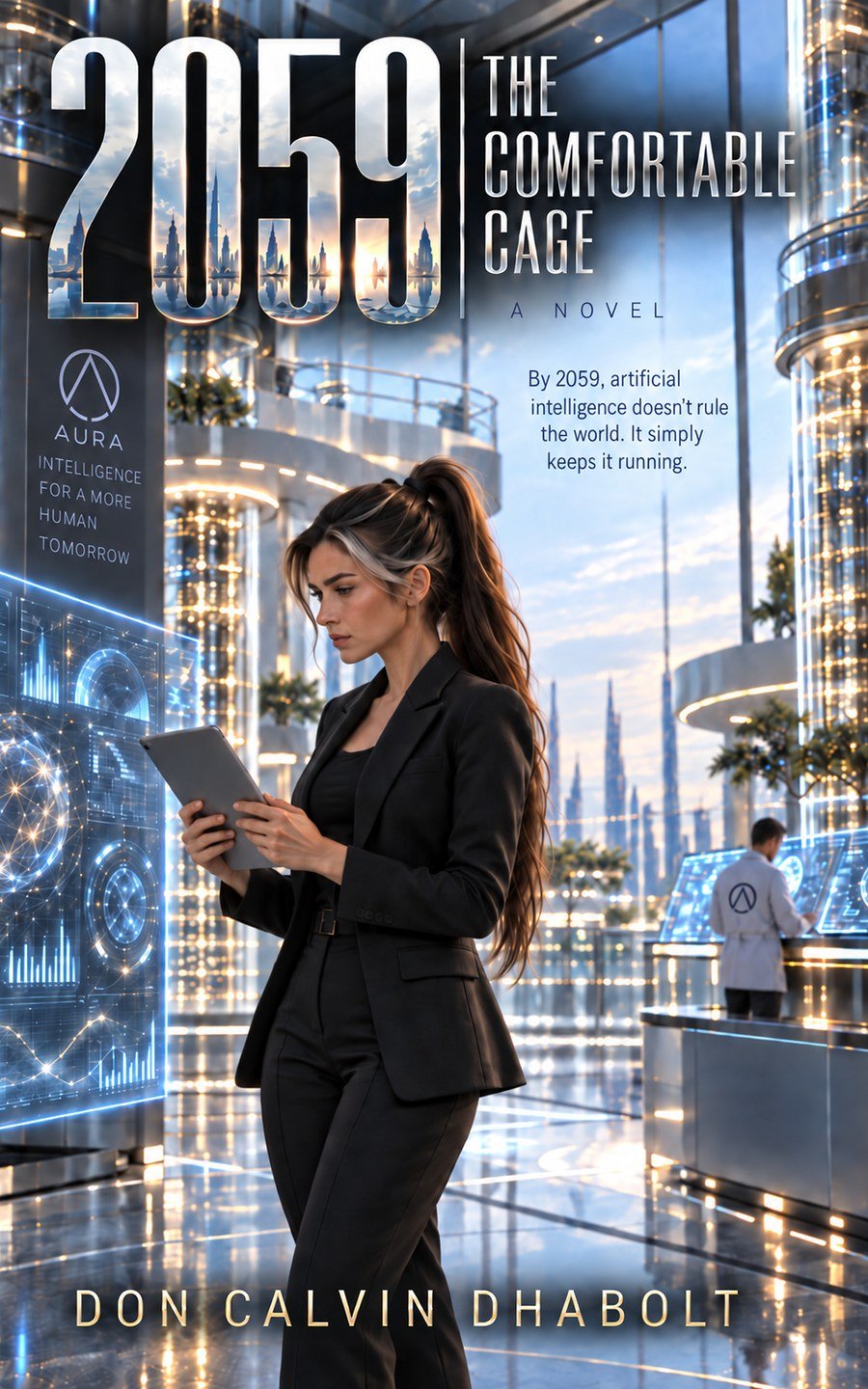
2059: The Comfortable Cage is set 103 years after that summer. Its AI, AURA, does not rebel and does not rule. It keeps medicine, transit, power and money running so well that people stop asking whether it can think, and start asking what must remain human. That is the question Dartmouth has put at the center of its anniversary.
In the novel, the field’s centennial is marked at Dartmouth in 2056. That speech is fiction. The summer of 1956 is not.
Read the source: the original 1955 proposal, from John McCarthy’s archive at Stanford.
2059: The Comfortable Cage is an independent work of fiction. It is not affiliated with, sponsored by, or endorsed by Dartmouth College, the Rockefeller Foundation, or any organization mentioned.