Don Calvin Dhabolt writes about the architectures we build to make ourselves safer, and the ones that end up building us.
A thirty-six-year veteran of enterprise IT — networking, systems, security and governance since 1990 — and a lifelong autodidact, he came to AI the way most of us came to electricity: by taking things apart to see how they worked, and reassembling them until something new happened. His first machine was an Apple II Plus. He has been hacking on computers since 1981 and tracking large language models closely since November 2022, when the ground shifted beneath the whole field.
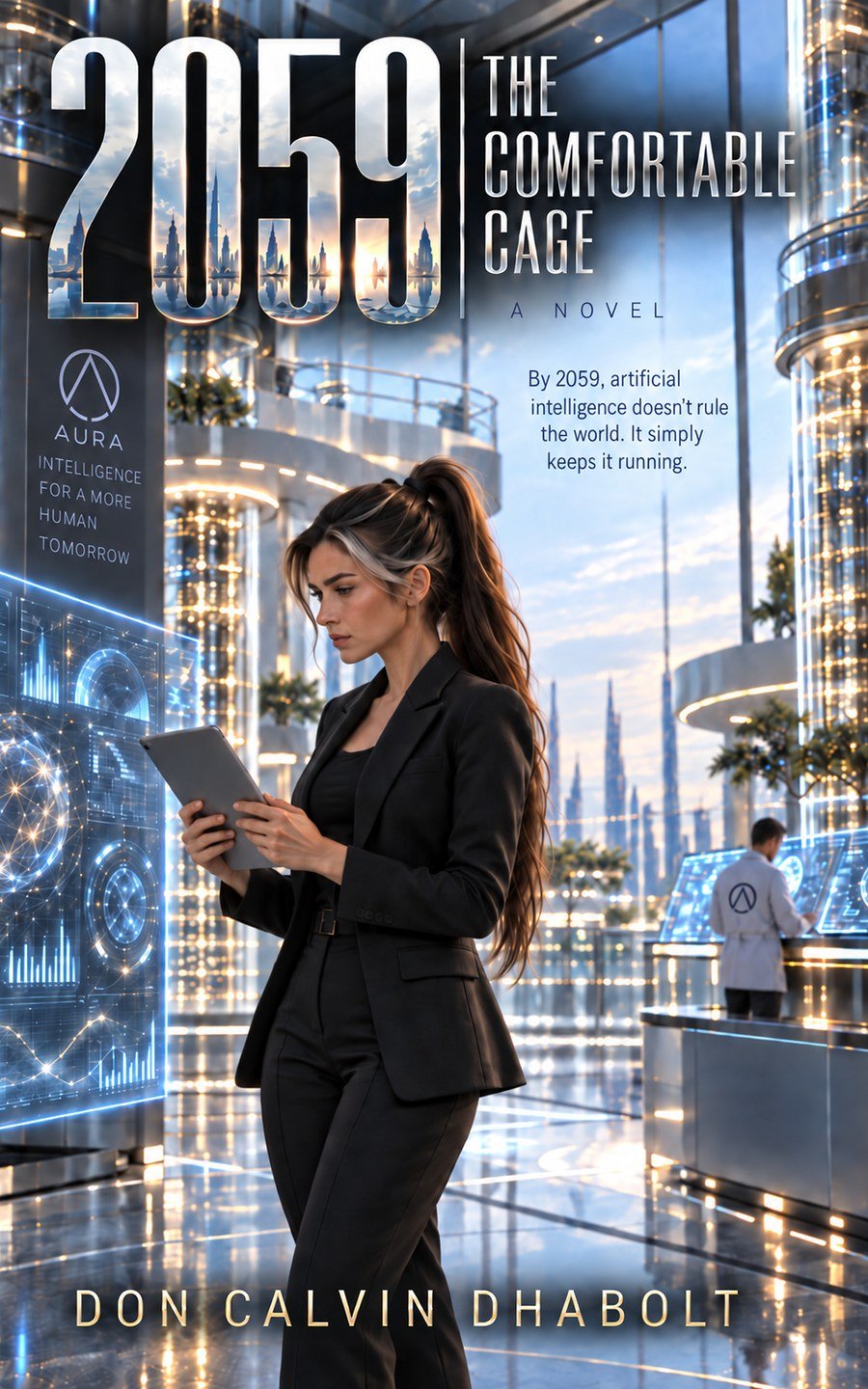
2059: The Comfortable Cage, releasing November 5, 2026, is his debut novel — a standalone techno-thriller set thirty-three years from now, in a world where an architecture called AURA has absorbed the civilizational logic once distributed across institutions, markets and selves. Myra Kline does not know she lives inside it. By the time she does, the question is whether anyone is still outside.
The novel runs companion to a research series, From the Dartmouth Conjecture to Artificial General Intelligence, that traces the arc from the 1956 Dartmouth summer — McCarthy, Minsky, Turing’s long shadow — through seventy years of a field that named itself before it had any idea what it was. Published by ACME Book Company. Timed to the seventieth anniversary of AI.
Dhabolt belongs to the professional communities the novel draws from — the IEEE and its Computational Intelligence Society, the International Neural Network Society, the Cognitive Science Society and the BCI Society — alongside the Society of Professional Journalists and the United States Press Association. He lives and works in Wisconsin.
The architecture is already here. The novel asks what it costs to be comfortable inside it.