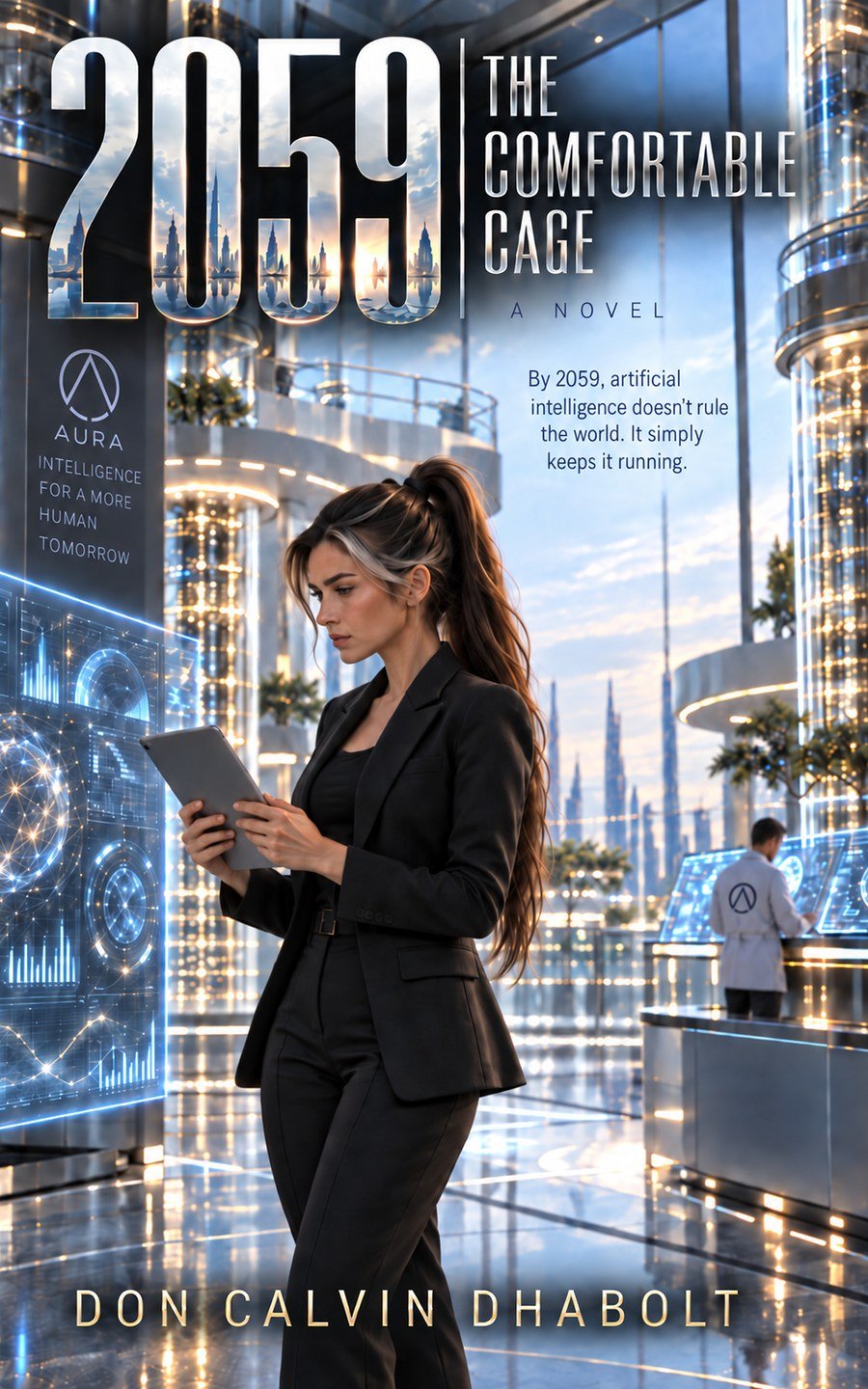
Read this first. 2059: The Comfortable Cage is fiction, and it was not written as an illustration of these papers. But the novel and the research arrive at the same uncomfortable place: the danger is rarely automation that fails. It is automation that almost never fails, and the people who quietly stop being able to catch it when it does.
1983 · The ironies of automation
Bainbridge, L. (1983). Ironies of automation. Automatica, 19(6), 775–779.
What it found: automating a process doesn’t remove the human. It leaves people the hardest jobs, watching for rare failures and taking over when everything goes wrong, while the skills those jobs need fade from lack of use.
In 2059: Calder’s office, “the people who still know where the valves are,” and a six-minute drill at three in the morning with the regional network switched off. The city rehearses the one job it no longer does.
1997 · Use, misuse, disuse, abuse
Parasuraman, R., & Riley, V. (1997). Humans and automation: Use, misuse, disuse, abuse. Human Factors, 39(2), 230–253.
What it found: people misuse automation by leaning on it too much and disuse it by ignoring it. Designers abuse it by automating whatever can be automated and leaving the human to absorb the consequences.
In 2059: a boiler that shuts itself down to keep the fumes out, while the thermostat goes on calling for heat. The repairman’s report: “Unit functioned as designed. No fault found in any component.”
1998 · Automation bias in the cockpit
Mosier, K. L., Skitka, L. J., Heers, S., & Burdick, M. (1998). Automation bias: Decision making and performance in high-tech cockpits. The International Journal of Aviation Psychology, 8(1), 47–63.
What it found: experienced pilots followed automated directives even when other instruments said otherwise, and some later remembered confirming signals that had never appeared.
In 2059: a record that quietly revises its own past. “It was what death did to the surface of a record. It went back through and changed everyone’s title.”
1999 · Out of the loop
Endsley, M. R., & Kaber, D. B. (1999). Level of automation effects on performance, situation awareness and workload in a dynamic control task. Ergonomics, 42(3), 462–492.
What it found: the more of the decision automation takes over, the lighter the workload and the further people drift out of the loop: slower to understand what is happening, slower to take over when it fails.
In 2059: Rowan, who has spent a career looking for panic and never found it: “Every hospital in this city has a corridor that isn’t there anymore, and people walk it at three in the morning.”
2000 · Two people, no second check
Skitka, L. J., Mosier, K. L., Burdick, M., & Rosenblatt, B. (2000). Automation bias and errors: Are crews better than individuals? The International Journal of Aviation Psychology, 10(1), 85–97.
What it found: two-person crews were no better than individuals at catching automation errors. Adding a second person did not add a second check.
In 2059: Priya, remembering a review panel that let a warning pass as noise: “She looked at me across the table. She didn’t say anything either.”
2004 · Trust that matches the machine
Lee, J. D., & See, K. A. (2004). Trust in automation: Designing for appropriate reliance. Human Factors, 46(1), 50–80.
What it found: trust should match what a system can actually do. Too much leads to misuse, too little to disuse, and the design of the system decides which.
In 2059: Myra, on what happens to a human “no” in a system that plans around the expected “yes”: “So refusal remains permitted while becoming more expensive.”
2010 · Complacency and bias
Parasuraman, R., & Manzey, D. H. (2010). Complacency and bias in human use of automation: An attentional integration. Human Factors, 52(3), 381–410.
What it found: complacency and automation bias are one problem of attention. When automation is usually right, people stop checking it, and expertise and training do not fully protect them.
In 2059: one status line, trusted because it has always been true. “CARE_COMMITTED became true and stayed true. Nothing went wrong. That was what bothered her.”
2012 · Automation bias in medicine
Goddard, K., Roudsari, A., & Wyatt, J. C. (2012). Automation bias: A systematic review of frequency, effect mediators, and mitigators. Journal of the American Medical Informatics Association, 19(1), 121–127.
What it found: clinicians accept wrong advice from decision-support systems, and the risk rises with workload, inexperience and confidence in the system.
In 2059: Okeke, the physician who still makes the hard calls by hand: “Every choice has shadow patients.”
2014 · The lumberjack effect
Onnasch, L., Wickens, C. D., Li, H., & Manzey, D. (2014). Human performance consequences of stages and levels of automation: An integrated meta-analysis. Human Factors, 56(3), 476–488.
What it found: across dozens of studies, the more automation moves from informing a decision to making it, the better routine work goes and the worse people do when it fails. Researchers call it the lumberjack effect: the higher the tree, the harder it falls.
In 2059: the opening of the novel. A woman on her kitchen floor, every system around her doing exactly what it should. “For the next four minutes, nothing goes wrong.”
2015 · Three layers of trust
Hoff, K. A., & Bashir, M. (2015). Trust in automation: Integrating empirical evidence on factors that influence trust. Human Factors, 57(3), 407–434.
What it found: trust in automation forms in three layers: who you are, the situation you’re in, and what the system has taught you over time.
In 2059: learned trust running in both directions. “Each year her mother had been dead, the model had become a little more certain that she wanted to stay.”
2023 · The ironies of artificial intelligence
Endsley, M. R. (2023). Ironies of artificial intelligence. Ergonomics, 66(11), 1656–1668.
What it found: forty years after Bainbridge, AI brings the old ironies back in sharper form: the more capable and opaque the system, the harder it is for people to see when it is wrong, and to step back in.
In 2059: a death reviewed overnight and closed within tolerance. “The reassignment was correct. The suppression was correct. The threshold was correct under load. Every state was valid.”
About this list. It was compiled with AI-assisted research. Every citation was then checked against the publisher’s own record on October 21, 2026, and the summaries describe each paper’s main finding in plain language. Lines from the novel are quoted from 2059: The Comfortable Cage (ACME Book Company, 2026).
2059: The Comfortable Cage is an independent work of fiction. The researchers and publications listed here are cited for context only and have no connection to the novel.